
In Chinese, each radical helps learners gradually uncover how characters are structured and formed. Radical 18 in Chinese (刀 – dāo) is one of the most common and practical radicals, appearing in many everyday words. In this guide, Ni Hao Ma will walk you through the meaning of radical 18, how to write it correctly, and a list of useful vocabulary to boost your Chinese learning.
What Is Radical 18 in Chinese?
Radical 18 (刀 – dāo) is the 18th radical in the traditional Kangxi system of 214 radicals. It commonly appears in characters related to actions such as cutting, slicing, dividing, or objects associated with sharp tools and instruments.
Historically, the character 刀 originated from oracle bone script, where it was a pictograph representing a knife with a curved blade and a clear handle. Over time, it evolved into its modern form.
Radical 18 appears in two main forms:
- 刀: the original form, used independently or positioned at the top/bottom of a character
- 刂: a variant form (often called the “standing knife radical”), typically appearing on the right side of characters
Semantically, the presence of radical 18 often signals meanings related to physical actions (cutting, trimming, separating) or direct impact on objects. Recognizing this pattern helps learners infer the meaning of unfamiliar characters more efficiently.
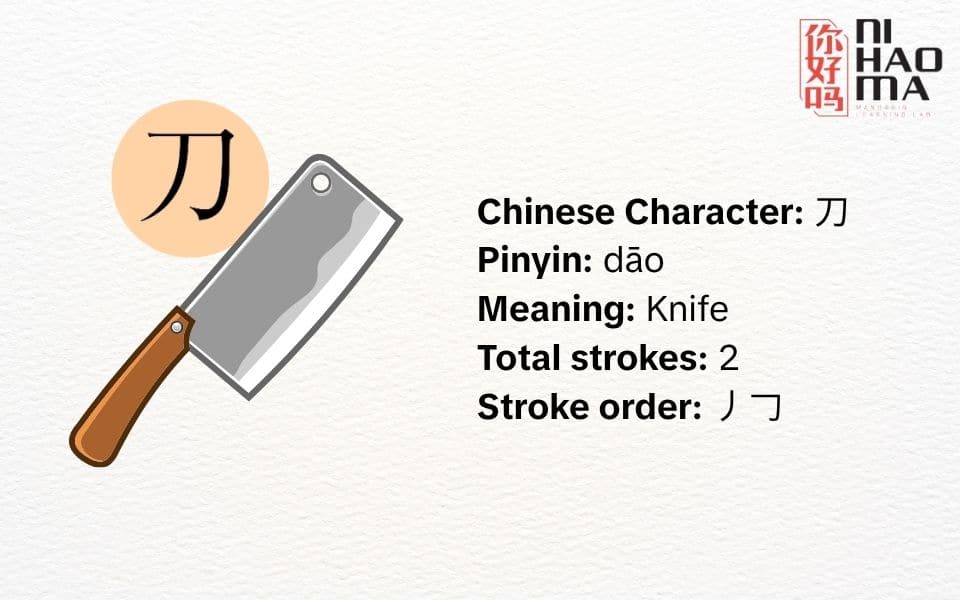
How to Write Radical 18 in Chinese
Radical 18 consists of 2 strokes, written in the following order:
| Stroke Order | Stroke | Description |
|---|---|---|
| 1 | 丿 | A left-falling stroke, written from top to bottom, slightly curved |
| 2 | 𠃌 | A hook stroke, starting downward then curving to the right |
When radical 18 (刀) appears on the right side of a character, it changes into its variant form 刂.
Distinguishing the Radical 18 (刀) and Radical 19 (力) in Chinese
The Dao radical (刀) and the Li radical (力) are two radicals that are easily confused in Chinese due to their similar shapes. However, if you observe closely, you can identify the following differences:
- Radical 18 (刀 – dāo): The throw stroke (left-falling stroke) stays neatly tucked under the horizontal-hook stroke and does not pierce through the top.
- Radical 19 (力 – lì): The throw stroke pierces through the horizontal-hook stroke, extending upward.
Beyond their appearance, these two radicals represent entirely different concepts:
- Radical 18 (刀 – dāo): Represents a knife or a sharp weapon. Characters containing the Dao radical are often related to actions of cutting, dividing, causing injury, or handheld tools. Examples: 分 (fēn – to divide), 切 (qiē/qiè – to cut).
- Radical 19 (力 – lì): Represents the shape of a flexed arm or an ancient wooden plow. Characters containing the Li radical are usually related to physical strength, labor, ability, or effort. Examples: 努 (nǔ – effort), 助 (zhù – to help/assist), 功 (gōng – merit/achievement).
Common Vocabulary with Radical 18
Radical 18 appears in many commonly used Chinese words, especially those describing actions or direct physical impact. Learning vocabulary by radical groups can significantly improve memory and help you guess meanings logically.
Below is a list of common words containing radical 18:
| Chinese | Pinyin | Meaning |
|---|---|---|
| 刀 | dāo | knife |
| 刃 | rèn | blade |
| 分 | fēn | divide |
| 切 | qiē | cut |
| 刊 | kān | publish |
| 刑 | xíng | punishment |
| 列 | liè | row, line |
| 初 | chū | beginning |
| 判 | pàn | judge |
| 别 | bié | different |
| 利 | lì | benefit, sharp |
| 到 | dào | arrive |
| 制 | zhì | make, control |
| 剑 | jiàn | sword |
| 剧 | jù | drama |
| 剪 | jiǎn | cut (with scissors) |
| 副 | fù | vice, assistant |
| 剩 | shèng | remain |
| 刀子 | dāozi | knife |
| 分开 | fēnkāi | separate |
| 分别 | fēnbié | distinguish |
| 分手 | fēnshǒu | break up |
| 分钟 | fēnzhōng | minute |
| 切开 | qiēkāi | cut open |
| 刑法 | xíngfǎ | criminal law |
| 列车 | lièchē | train |
| 别人 | biérén | others |
| 利用 | lìyòng | make use of |
| 利益 | lìyì | benefit |
| 削弱 | xuēruò | weaken |
| 剪刀 | jiǎndāo | scissors |
| 判断 | pànduàn | judge, determine |
| 制度 | zhìdù | system |
| 利润 | lìrùn | profit |
| 到底 | dàodǐ | after all |
| 刚刚 | gānggāng | just now |
| 特别 | tèbié | special |
Sample Dialogues Using Radical 18 Vocabulary
After learning vocabulary that contains radical 18, placing these words into real-life communication contexts is one of the most effective ways to understand their usage and retain them long-term. The following dialogues are based on common daily situations, helping you see how these words naturally appear in everyday Chinese.
Dialogue 1
A: 这里的西瓜在打折,买一个吧,挺划算的。
(Zhèlǐ de xīguā zài dǎzhé, mǎi yīgè ba, tǐng huásuàn de.)
The watermelons here are on sale—let’s buy one, it’s a great deal.
B: 好啊,但是家里没有水果刀,得买一把。
(Hǎo a, dànshì jiālǐ méiyǒu shuǐguǒdāo, děi mǎi yī bǎ.)
Sure, but we don’t have a fruit knife at home—we need to buy one.
A: 没问题。请问,可以用手机支付还是必须刷卡?
(Méi wèntí. Qǐngwèn, kěyǐ yòng shǒujī zhīfù háishì bìxū shuākǎ?)
No problem. Excuse me, can we pay by phone or do we have to use a card?
B: 都可以,现在的支付方式非常便利。
(Dōu kěyǐ, xiànzài de zhīfù fāngshì fēicháng biànlì.)
Both are fine—payment methods are very convenient nowadays.
A: 那就好,我们快去排队吧。
(Nà jiù hǎo, wǒmen kuài qù páiduì ba.)
Great, let’s go line up.
Dialogue 2
A: 你在做什么?
(Nǐ zài zuò shénme?)
What are you doing?
B: 我在切菜。
(Wǒ zài qiē cài.)
I’m cutting vegetables.
A: 小心点,刀很锋利。
(Xiǎoxīn diǎn, dāo hěn fēnglì.)
Be careful – the knife is very sharp.
B: 放心吧,我已经切完了。
(Fàngxīn ba, wǒ yǐjīng qiē wán le.)
Don’t worry, I’ve already finished cutting.
A: 那你可以帮我削水果吗?
(Nà nǐ kěyǐ bāng wǒ xiāo shuǐguǒ ma?)
Can you help me peel some fruit?
B: 没问题。
(Méi wèntí.)
No problem.
Dialogue 3
A: 医生,我的伤口需要手术吗?
(Yīshēng, wǒ de shāngkǒu xūyào shǒushù ma?)
Doctor, does my wound require surgery?
B: 情况不严重,不过需要切开处理。
(Qíngkuàng bù yánzhòng, búguò xūyào qiēkāi chǔlǐ.)
It’s not serious, but we need to cut it open for treatment.
A: 手术需要多长时间?
(Shǒushù xūyào duō cháng shíjiān?)
How long will the surgery take?
B: 大概三十分钟,你不用担心。
(Dàgài sānshí fēnzhōng, nǐ búyòng dānxīn.)
About 30 minutes—no need to worry.
A: 好的,谢谢医生。
(Hǎo de, xièxie yīshēng.)
Okay, thank you, doctor.
Conclusion
This article by Ni Hao Ma has provided a clear overview of radical 18 in Chinese, along with practical vocabulary and real-life dialogue examples to support your learning. These words are widely used in modern communication and can significantly improve your fluency when applied correctly.
However, consistent practice remains essential. By regularly reviewing vocabulary, practicing writing, and using these expressions in context, you can develop a more natural and confident command of Chinese. Keep exploring more radicals, and you’ll continue to build a strong foundation for long-term language success.