In Chinese, there are two different radicals that share the same pinyin “Mì”, which often confuses learners when studying and looking up Chinese characters. To avoid this confusion, it is essential to clearly understand the form, meaning, and stroke order of each radical. In this guide, we will explore both radical 14 and radical 120, from their structure and writing rules to practical vocabulary and usage.
Radical 14 and Radical 120 in Chinese
The “mì” radical refers to important components used in the formation of many common Chinese characters. However, beginners often struggle because there are two completely different radicals with the same name but distinct shapes and meanings. Understanding the difference between radical 14 and radical 120 will significantly improve your ability to recognize and memorize Chinese characters.
Radical 14 (冖)
Radical 14 (冖 – mì) is one of the 214 Kangxi radicals. It visually represents a covering cloth or a veil draped over an object, symbolizing the idea of covering, sheltering, or enclosing.
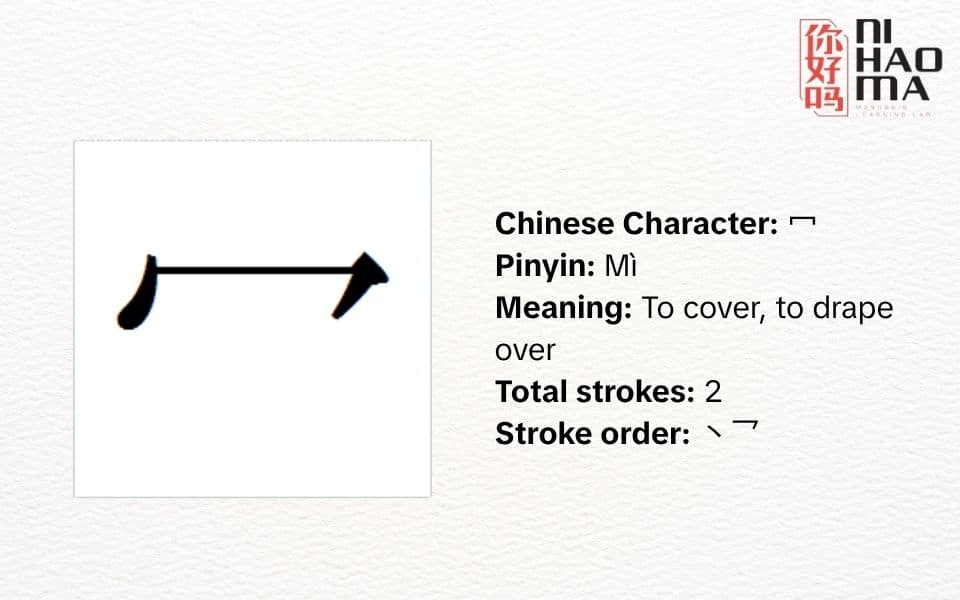
In terms of structure, radical 14 is relatively simple, consisting of a short stroke combined with a curved horizontal stroke. In ancient scripts such as oracle bone inscriptions and bronze inscriptions, its form clearly resembled a piece of cloth covering something beneath it.
When used as a component in Chinese characters, radical 14 typically appears at the top and conveys meanings related to protection, enclosure, or something hidden beneath a cover.
Radical 120 (糸 / 纟)
Radical 120 (糸 – mì / simplified form 纟) is another key radical in Chinese, associated with silk, threads, and connections.
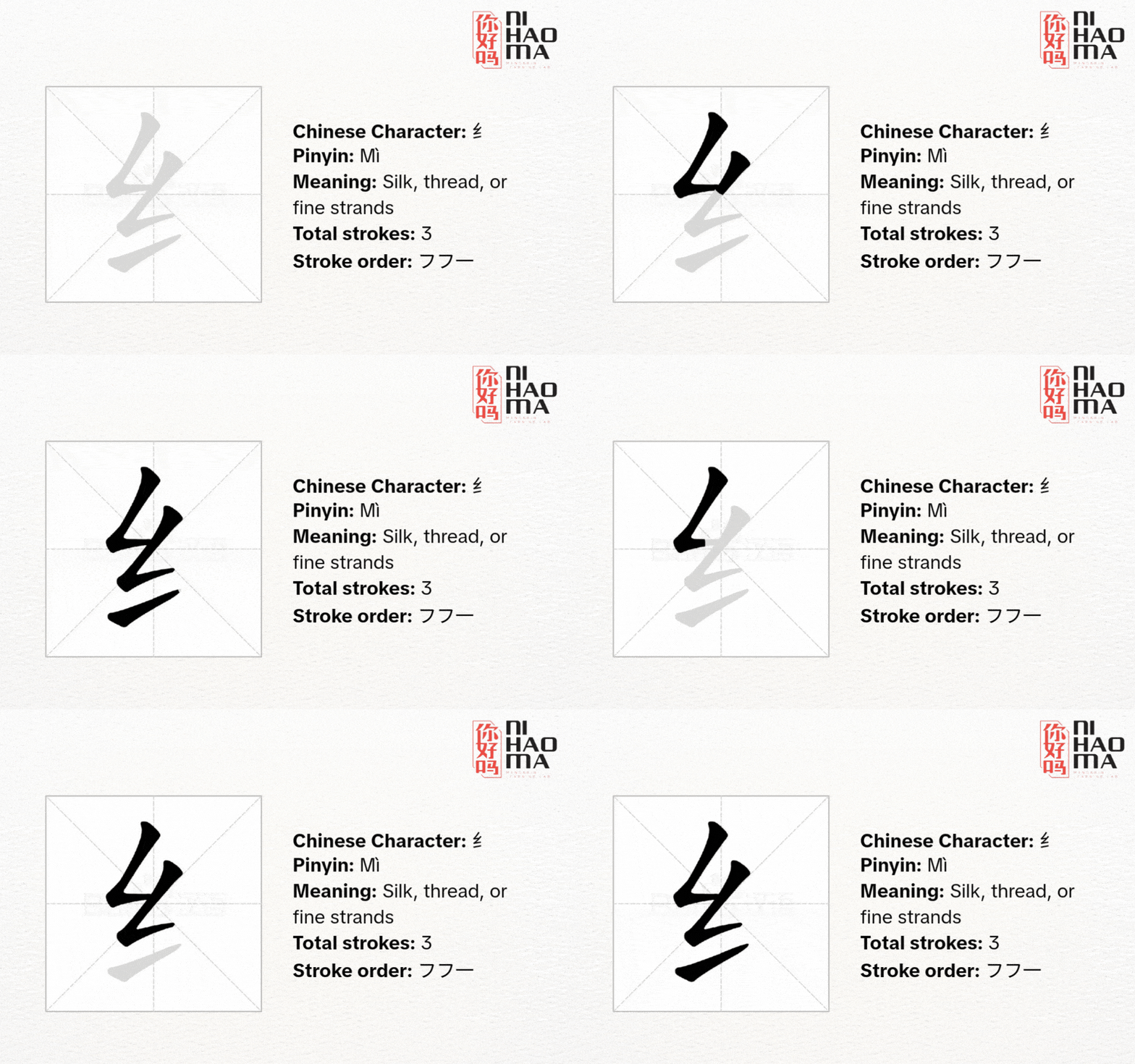
In ancient writing systems, this radical appeared as a complex structure representing intertwined silk threads. In modern Chinese, the traditional form 糸 retains many of these intricate strokes, while the simplified form 纟 reduces the number of strokes for easier writing while preserving its core meaning.
As a radical, radical 120 is commonly placed on the left side of characters and is associated with meanings related to textiles, binding, relationships, sequences, and even colors. In modern Chinese, it is one of the most productive radicals, appearing in a large number of commonly used words.
How to Write Radical 14 and Radical 120
Mastering the stroke order of these radicals not only helps you write correctly but also makes it easier to distinguish between them. Each radical has its own structure and typical position within a character, reflecting its original meaning.
How to Write Radical 14 (冖)
Radical 14 consists of 2 strokes and is typically placed at the top of a character:
| Stroke Order | Stroke | Description |
|---|---|---|
| 1 | 丶 | A dot or short downward stroke written from left to right |
| 2 | 乛 | A horizontal stroke that curves downward at the end |
How to Write Radical 120 (纟)
The simplified form 纟 consists of 3 strokes and usually appears on the left side of a character:
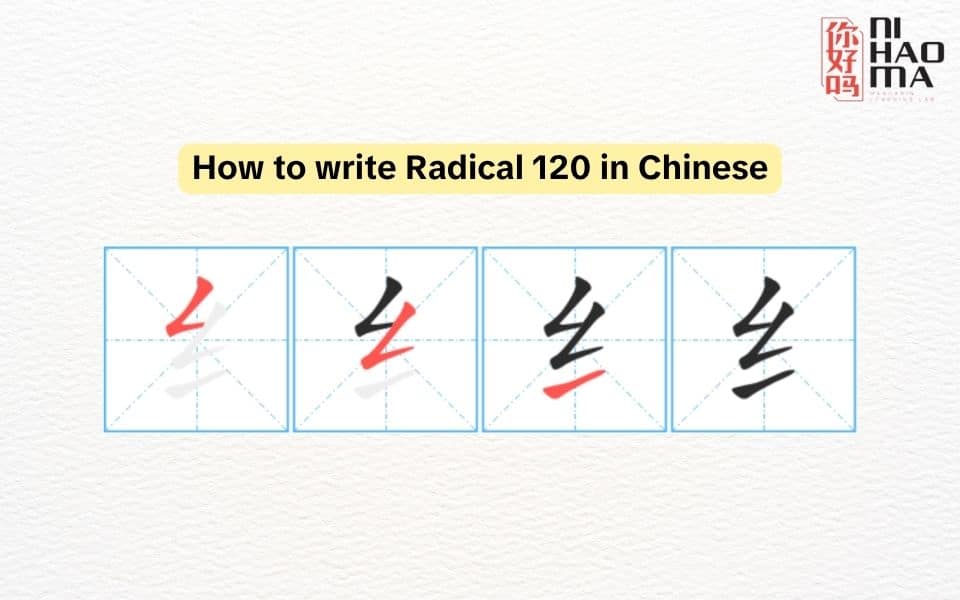
| Stroke Order | Stroke | Description |
|---|---|---|
| 1 | フ | A turning stroke starting from top and bending to the right |
| 2 | フ | A second turning stroke similar to the first |
| 3 | ㇀ | A rising stroke written upward to finish the character |
Vocabulary with Radical 14 (冖)
Radical 14 typically appears at the top of characters and originally conveys the idea of covering or enclosure. However, in modern usage, it mainly serves as a structural and semantic hint rather than retaining its literal meaning.
Here are some common words containing radical 14:
| Chinese | Pinyin | Meaning |
|---|---|---|
| 军 | jūn | Army |
| 写 | xiě | To write |
| 冠 | guān | Crown |
| 冥 | míng | Dark, obscure |
| 冢 | zhǒng | Tomb |
| 冤 | yuān | Injustice |
| 农 | nóng | Agriculture |
| 冠军 | guànjūn | Champion |
| 军人 | jūnrén | Soldier |
| 军队 | jūnduì | Army |
| 军事 | jūnshì | Military affairs |
| 军装 | jūnzhuāng | Military uniform |
| 军功 | jūngōng | Military merit |
| 军令 | jūnlìng | Military order |
| 军旗 | jūnqí | Military flag |
| 写字 | xiězì | To write characters |
| 冠冕 | guānmiǎn | Crown, ceremonial hat |
| 冤家 | yuānjiā | Enemy (in a fated sense) |
| 冤枉 | yuānwǎng | Wronged |
| 冤案 | yuān’àn | Miscarriage of justice |
| 冢墓 | zhǒngmù | Tomb |
| 军医 | jūnyī | Military doctor |
| 冥顽 | míngwán | Stubborn, ignorant |
| 冥冥 | míngmíng | Dim, obscure |
| 冤情 | yuānqíng | Grievance |
| 冠子 | guānzi | Hat |
Vocabulary with Radical 120 (纟)
In modern Chinese, radical 120 often appears on the left side and is strongly associated with connection, structure, and relationships. Below are common words containing radical 120:
| Chinese | Pinyin | Meaning |
|---|---|---|
| 红 | hóng | Red |
| 纸 | zhǐ | Paper |
| 级 | jí | Level |
| 练 | liàn | Practice |
| 给 | gěi | Give |
| 经 | jīng | Pass through, scripture |
| 结 | jié | Tie, result |
| 终 | zhōng | End |
| 绿 | lǜ | Green |
| 线 | xiàn | Line |
| 细 | xì | Fine, detailed |
| 总 | zǒng | Total |
| 绝 | jué | Absolute |
| 续 | xù | Continue |
| 维 | wéi | Maintain |
| 编 | biān | Compile |
| 缴 | jiǎo | Pay (fees) |
| 约 | yuē | Appointment |
| 纪 | jì | Discipline, record |
| 统 | tǒng | Unite |
| 纯 | chún | Pure |
| 织 | zhī | Weave |
| 纲 | gāng | Outline |
| 纳 | nà | Accept |
| 纵 | zòng | Vertical, indulge |
| 纷 | fēn | Numerous |
| 纠 | jiū | Correct |
| 纹 | wén | Pattern |
| 纺 | fǎng | Spin |
| 纽 | niǔ | Button |
| 组 | zǔ | Group |
| 继续 | jìxù | Continue |
| 细心 | xìxīn | Careful |
| 终于 | zhōngyú | Finally |
| 经验 | jīngyàn | Experience |
| 结果 | jiéguǒ | Result |
| 练习 | liànxí | Practice |
| 经典 | jīngdiǎn | Classic |
| 结束 | jiéshù | End |
| 结论 | jiélùn | Conclusion |
| 绿色 | lǜsè | Green color |
| 经常 | jīngcháng | Often |
| 纪念 | jìniàn | Commemorate |
| 绝对 | juéduì | Absolute |
| 组织 | zǔzhī | Organize |
| 统一 | tǒngyī | Unify |
| 维持 | wéichí | Maintain |
Sample Dialogues with Radical 14 and Radical 120
Learning vocabulary through context is one of the most effective ways to retain knowledge. Below are two short dialogues demonstrating how words containing radical 14 and radical 120 are used in everyday communication.
Dialogue with Radical 14 (冖)
A: 你昨天写完那篇作文了吗?
(Nǐ zuótiān xiě wán nà piān zuòwén le ma?)
Did you finish writing that essay yesterday?
B: 还没有,我写得比较慢,而且内容有点难。
(Hái méiyǒu, wǒ xiě de bǐjiào màn, érqiě nèiróng yǒudiǎn nán.)
Not yet, I write quite slowly and the content is a bit difficult.
A: 老师说明天一定要交,你最好今天写完。
(Lǎoshī shuō míngtiān yídìng yào jiāo, nǐ zuìhǎo jīntiān xiě wán.)
The teacher said it must be submitted tomorrow, so you’d better finish it today.
B: 好的,我今晚会继续写,希望能早点完成。
(Hǎo de, wǒ jīnwǎn huì jìxù xiě, xīwàng néng zǎodiǎn wánchéng.)
Okay, I’ll continue writing tonight and hope to finish early.
Dialogue with Radical 120 (纟)
A: 这个项目需要重新组织一下结构。
(Zhège xiàngmù xūyào chóngxīn zǔzhī yíxià jiégòu.)
This project needs to reorganize its structure.
B: 我同意,我们现在的系统有点乱。
(Wǒ tóngyì, wǒmen xiànzài de xìtǒng yǒudiǎn luàn.)
I agree, our current system is a bit messy.
A: 那你先联系一下相关的成员,我们一起开个会讨论。
(Nà nǐ xiān liánxì yíxià xiāngguān de chéngyuán, wǒmen yìqǐ kāi gè huì tǎolùn.)
Then contact the relevant members first, and we’ll have a meeting.
B: 好的,我会整理资料,然后继续推进这个项目。
(Hǎo de, wǒ huì zhěnglǐ zīliào, ránhòu jìxù tuījìn zhège xiàngmù.)
Sure, I’ll organize the materials and continue moving the project forward.
Conclusion
Understanding the difference between radical 14 and radical 120 is a crucial step in mastering Chinese characters. By learning their meanings, positions, and common vocabulary, you can significantly improve your reading, writing, and comprehension skills.
Keep practicing radicals consistently, as they form the foundation of the Chinese writing system and make vocabulary learning more logical, structured, and efficient. Stay tuned and keep following Ni Hao Ma to know more interesting radicals!