Among the 214 Kangxi radicals, there is one that appears on the very first pages of your HSK 1 textbook and accompanies you through a vast amount of daily vocabulary. That is radical 39 in Chinese. Mastering this specific component will help you decode hundreds of other Chinese characters with ease. Let’s join Ni Hao Ma to discover its detailed meaning, stroke order, and a highly practical vocabulary repository right now!
What is Radical 39 in Chinese?
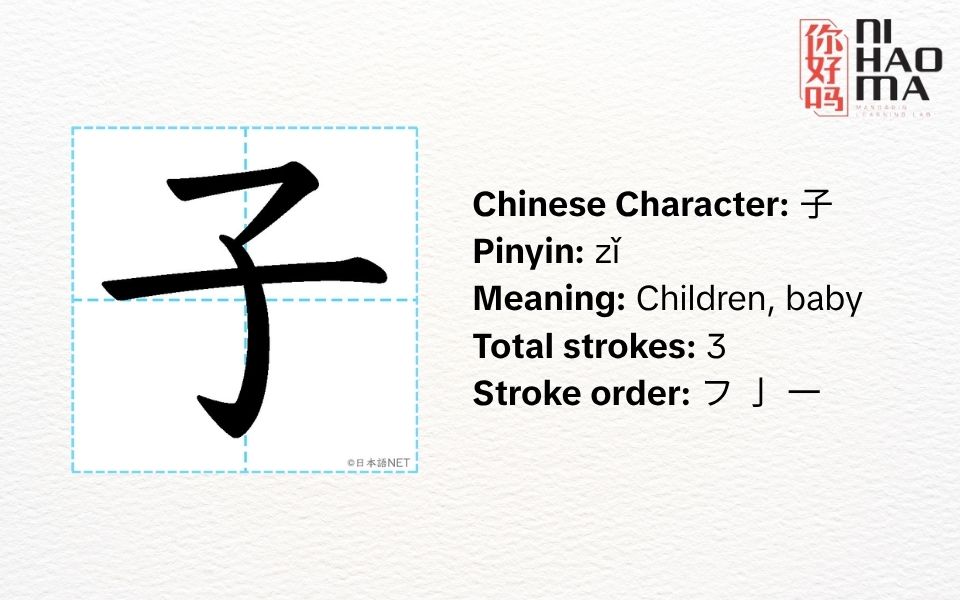
Radical 39 in Chinese (written as 子, pinyin: zǐ) is the 39th radical in the Kangxi system. It stands out as one of the most fundamental and familiar structural building blocks in Chinese characters.
When we travel back in time to examine Oracle Bone Script, the character 子 vividly pharacterized a newborn infant wrapped in a swaddling cloth that tapered at the legs, with two arms spread wide open and moving, topped by a noticeably large, round head. Over centuries of script development, 子 was gradually simplified into the balanced form we see today.
Throughout thousands of years of character evolution, this radical has firmly retained its core symbolic meaning: it represents children, a child, the future generation, or seed-like traits of reproduction and growth. Understanding this symbolic essence is your “secret weapon” for guessing the meanings of complex characters.
Example: In the character 好 (hǎo – good, well), we see a combination of the “Woman” radical (女 – nǚ) and radical 39 in Chinese (子 – con cái). In ancient Chinese culture, a woman giving birth to a child signified completeness, prosperity, and good fortune.
How to Write Radical 39 in Chinese
Because its structure consists of only 3 strokes, writing radical 39 in Chinese is not complicated at all. Follow this precise stroke sequence:
| Stroke Order | Stroke Name | Writing Description |
| 1 | ㇇ (Turning stroke) | Write a short horizontal line from left to right, then fold downward and curve slightly to the left. |
| 2 | 亅 (Vertical hook) | Place your pen at the fold corner of the first stroke, pull a straight vertical line downward, and hook up to the left. |
| 3 | 一 (Horizontal stroke) | Write a crisp horizontal line from left to right, cutting straight through the vertical line to balance the character. |
Positions of Radical 39 in Chinese Characters
When functioning as a radical, Radical 39 in Chinese can appear in different positions within a character. Recognizing these positions helps learners analyze character structure more effectively.
Radical 39 on the Left Side
When 子 appears on the left side, its bottom horizontal stroke is often shortened or modified to create space for the component on the right. Examples: 孙 (sūn – Grandchild), 孤 (gū – Lonely; orphan).
Radical 39 at the Bottom
When located on the lower half of a top-to-bottom structural layout, it is written in its original form with a fully extended horizontal line, provides a steady base for the upper components. Examples: 学 (xué – to study/learn), 季 (jì – season/quarter).
Radical 39 on the Right Side
This setup is less frequent than the left-hand position. In this arrangement, 子 maintains its long horizontal stroke instead of transforming into a rising stroke, typically functioning as a semantic indicator. Example: 好 (hǎo – good/beautiful).
Comprehensive Vocabulary Featuring Radical 39 in Chinese
To truly master radical 39 in Chinese, you need to study its vocabulary and apply it to real-life situations. Interestingly, it functions seamlessly as both an embedded radical component and a standalone noun or suffix.
To help you accumulate vocabulary systematically, Ni Hao Ma has compiled a comprehensive repository of words containing this radical, organized progressively from basic to advanced levels:
| Chinese Character | Pinyin | Meaning |
| 子 | zǐ | Child, infant, seed, noun suffix |
| 字 | zì | Character, script, word |
| 孔 | kǒng | Hole, aperture, Confucius |
| 好 | hǎo | Good, fine, excellent |
| 存 | cún | To exist, store, deposit |
| 孝 | xiào | Filial piety, filial |
| 季 | jì | Season, period, quarter |
| 学 | xué | To study, learn, science |
| 孙 | sūn | Grandchild, descendant |
| 孟 | mèng | First month of a season, Mencius |
| 孤 | gū | Lonely, orphaned |
| 孩 | hái | Child |
| 孜 | zī | Industrious, diligent |
| 孺 | rú | Child, infant |
| 孽 | niè | Evil, sin, consequence |
| 孩子 | háizi | Child, children |
| 儿子 | érzi | Son |
| 女儿 | nǚ’ér | Daughter |
| 子女 | zǐnǚ | Sons and daughters, children |
| 孙子 | sūnzi | Grandson |
| 父子 | fùzǐ | Father and son |
| 母子 | mǔzǐ | Mother and child |
| 弟子 | dìzǐ | Disciple, student |
| 学生 | xuésheng | Student, pupil |
| 学校 | xuéxiào | School |
| 学习 | xuéxí | To study, learn |
| 学问 | xuéwèn | Knowledge, learning |
| 学费 | xuéfèi | Tuition fees |
| 字典 | zìdiǎn | Dictionary |
| 汉字 | Hànzì | Chinese character |
| 写字 | xiězì | To write characters |
| 名字 | míngzi | Name |
| 生字 | shēngzì | New character, unfamiliar word |
| 孤儿 | gū’ér | Orphan |
| 孕妇 | yùnfù | Pregnant woman |
| 季节 | jìjié | Season |
| 季度 | jìdù | Quarter (of a financial/academic year) |
| 存在 | cúnzài | To exist, existence |
| 保存 | bǎocún | To preserve, conserve, save |
| 孝顺 | xiàoshùn | Filial, show filial obedience |
| 王子 | wángzǐ | Prince |
| 太子 | tàizǐ | Crown prince |
| 种子 | zhǒngzi | Seed |
| 子孙 | zǐsūn | Descendants, posterity |
| 桌子 | zhuōzi | Table, desk |
| 椅子 | yǐzi | Chair |
| 房子 | fángzi | House, building, room |
| 帽子 | màozi | Hat, cap |
| 鞋子 | xiézi | Shoes |
| 袜子 | wàzi | Socks, stockings |
| 裤子 | kùzi | Trousers, pants |
| 裙子 | qúnzi | Skirt, dress |
| 镜子 | jǐngzi | Mirror |
| 杯子 | bēizi | Cup, glass |
| 梳子 | shūzi | Comb |
| 勺子 | sháozi | Spoon |
| 刀子 | dāozi | Knife |
| 本子 | běnzi | Notebook, book |
| 胖子 | pàngzi | Fat person |
| 兔子 | tùzi | Rabbit, hare |
| 狮子 | shīzi | Lion |
| 饺子 | jiǎozi | Dumpling, jiaozi |
Sample Dialogues with Radical 39 Vocabulary
Learning words out of context makes them easy to forget. Let’s look at how words utilizing radical 39 in Chinese flow naturally in everyday daily conversations.
Dialogue 1
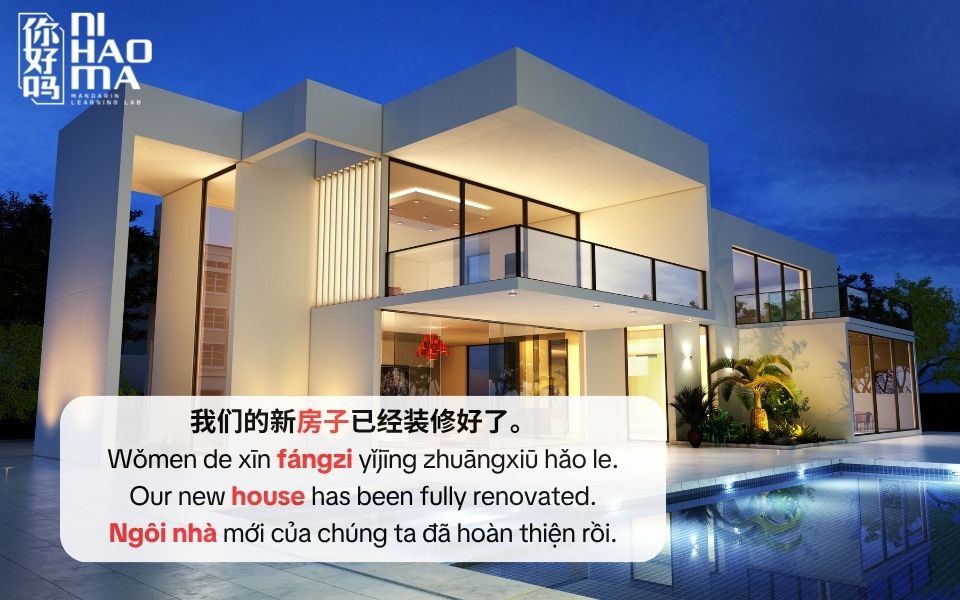
A: 我们的新房子已经装修好了。
Wǒmen de xīn fángzi yǐjīng zhuāngxiū hǎo le.
Our new house has been fully renovated.
B: 那我们先买一张桌子和几把椅子吧。
Nà wǒmen xiān mǎi yì zhāng zhuōzi hé jǐ bǎ yǐzi ba.
Let’s buy a table and some chairs first.
A: 客厅放什么样的桌子比较好?
Kètīng fàng shénme yàng de zhuōzi bǐjiào hǎo?
What kind of table should we put in the living room?
B: 简单一点就很好看。
Jiǎndān yìdiǎn jiù hěn hǎokàn.
A simple one would look great.
Dialogue 2
A: 你有几个孩子?
Nǐ yǒu jǐ gè háizi?
How many children do you have?
B: 我有两个孩子,一个儿子,一个女儿。
Wǒ yǒu liǎng gè háizi, yí gè érzi, yí gè nǚ’ér.
I have two children, a son and a daughter.
A: 你的儿子今年多大了?
Nǐ de érzi jīnnián duō dà le?
How old is your son this year?
B: 他十岁了,我的女儿七岁。
Tā shí suì le, wǒ de nǚ’ér qī suì.
My son is ten, and my daughter is seven.
Dialogue 3
A: 请问,你们想吃什么?
Qǐngwèn, nǐmen xiǎng chī shénme?
What would you like to eat?
B: 我想吃饺子,你呢?
Wǒ xiǎng chī jiǎozi, nǐ ne?
I’d like dumplings. What about you?
C: 我也喜欢饺子,再来两碗汤吧。
Wǒ yě xǐhuān jiǎozi, zài lái liǎng wǎn tāng ba.
I like dumplings too. Let’s order two bowls of soup as well.
A: 好的,请稍等。
Hǎo de, qǐng shāoděng.
Certainly. Please wait a moment.
Conclusion
Learning Chinese characters does not have to be overwhelming. By studying radicals systematically, you can transform Chinese from something intimidating into an enjoyable and logical language to master.
As one of the most important Kangxi radicals, Radical 39 in Chinese provides valuable clues about meanings related to children, family, education, growth, and future generations. By understanding its origin, mastering its writing, and practicing vocabulary in real-life contexts, you will significantly improve your Chinese reading and vocabulary-building skills.
If you are looking for a structured Chinese learning program with personalized guidance and a practical approach to listening, speaking, reading, and writing, Ni Hao Ma is ready to accompany you on your Chinese learning journey.