
Among the 214 Kangxi radicals, there is one particularly interesting component that frequently appears in everyday topics related to movement, transportation, walking, and sports – Radical 157 (足).
But what does Radical 157 symbolize in Chinese characters? How can learners use this radical to understand vocabulary more effectively and improve memorization? In this guide, we’ll explore everything you need to know about Radical 157 in Chinese, from its meaning and writing method to practical vocabulary and real-life conversations.
What Is Radical 157 in Chinese?
Radical 157 (足 – zú) is the 157th radical among the 214 traditional Kangxi radicals. When used as an independent character, 足 means foot, leg, or to be sufficient and complete.
The earliest form of 足 in oracle bone script resembled a human leg. The upper part represented the thigh, the middle part represented the knee, and the lower part represented the foot. Over thousands of years of script evolution, the character gradually transformed into its modern form, consisting of a top component resembling 口 and a lower component depicting a foot in motion.
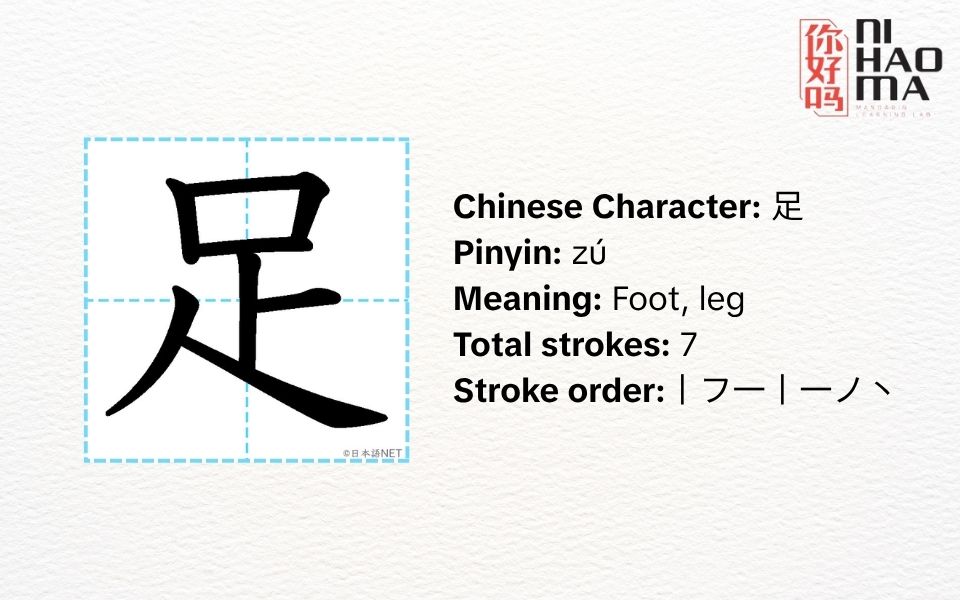
As an independent character, 足 contains seven strokes. However, when it functions as a character component, it often appears in its radical form ⻊, commonly referred to as the standing form of Radical 157. Although the total number of strokes remains the same, the final stroke changes shape to accommodate other character components.
Because of its association with feet, walking, and movement, Radical 157 is commonly found in characters related to transportation, sports, physical actions, and motion.
How to Write Radical 157 in Chinese
Understanding the correct stroke order helps learners write more accurately and retain characters more effectively. Below is the standard stroke order for 足:
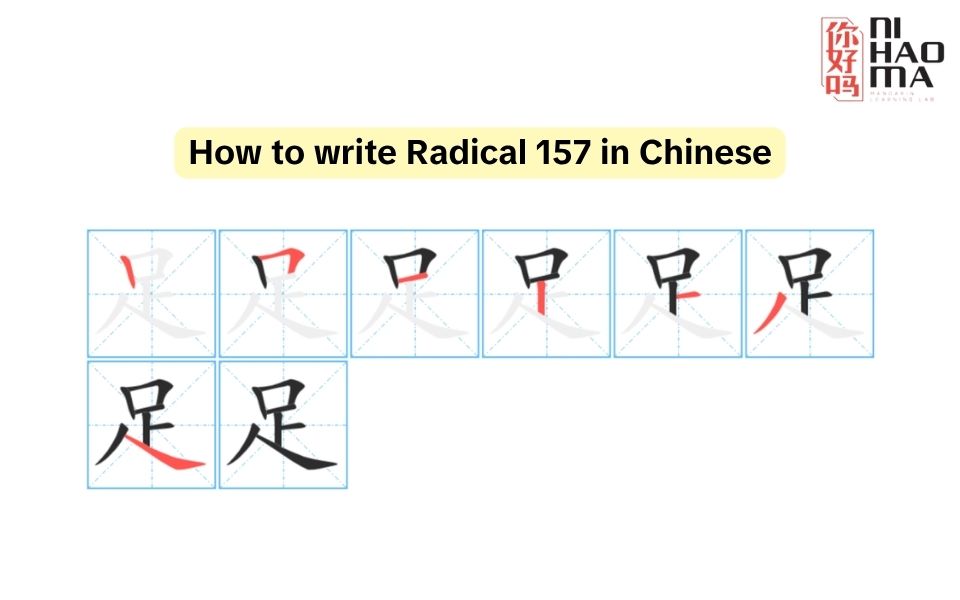
| Stroke Order | Stroke Name | Description |
| 1 | 丨(Vertical) | Write a straight vertical line from top to bottom, forming the left edge of the upper component. |
| 2 | 𠃍 (Horizontal Turn) | Start from the top of stroke 1, draw horizontally to the right, then bend 90 degrees downward. |
| 3 | 一 (Horizontal) | Draw a horizontal line from left to right to close the square frame (creating the 口 component). |
| 4 | 丨(Vertical) | From the bottom of the 口 frame, draw a short vertical line downward to act as the leg axis. |
| 5 | 一 (Horizontal) | Draw a short horizontal line intersecting the 4th vertical stroke. |
| 6 | 丿(Left-falling) | Sweep a gentle slash from the top down toward the bottom left. |
| 7 | 乀 / ㇀ (Rise) | Standalone (足): Write a long downward press from left to right. Radical form (⻊): Change the press into a rising stroke from bottom-left to top-right. |
Important note: The upper 口 component should be written compactly, occupying about 1/3 of the total character height, allowing the lower “foot” section to look elegant and elongated.
Vocabulary Featuring Radical 157 in Chinese
Learning radicals without linking them to practical vocabulary keeps your knowledge trapped on paper. To help you expand your vocabulary systematically, Ni Hao Ma has curated a high-frequency list of over 50 vocabulary words featuring radical 157 that appear regularly in daily life, HSK/HSKK exams, and workplaces:
| Chinese | Pinyin | Meaning |
|---|---|---|
| 足 | zú | Foot; leg; sufficient; enough |
| 路 | lù | Road; street; route |
| 跑 | pǎo | To run |
| 跳 | tiào | To jump |
| 跟 | gēn | To follow; heel |
| 趴 | pā | To lie face down |
| 跌 | diē | To fall |
| 踢 | tī | To kick |
| 踩 | cǎi | To step on; tread on |
| 跪 | guì | To kneel |
| 跑步 | pǎobù | To jog; running |
| 跳舞 | tiàowǔ | To dance |
| 跳远 | tiàoyuǎn | Long jump |
| 路线 | lùxiàn | Route; itinerary |
| 路口 | lùkǒu | Intersection; crossroads |
| 路边 | lùbiān | Roadside |
| 路灯 | lùdēng | Streetlight |
| 路程 | lùchéng | Distance; journey |
| 路途 | lùtú | Journey; trip |
| 满足 | mǎnzú | To satisfy; satisfied |
| 马路 | mǎlù | Road; roadway |
| 跟踪 | gēnzōng | To track; follow; monitor |
| 充足 | chōngzú | Sufficient; abundant |
| 足球 | zúqiú | Football; soccer |
| 跪拜 | guìbài | To kneel and worship |
| 飞跃 | fēiyuè | Leap; breakthrough; rapid progress |
| 足额 | zú’é | Full amount; complete quota |
| 距离 | jùlí | Distance |
| 踉跄 | liàngqiàng | To stagger; stumble |
| 奇迹 | qíjì | Miracle |
| 高攀 | gāopān | To associate with someone of higher status; to reach above one’s social standing |
| 跳槽 | tiàocáo | To change jobs; job-hop |
| 立足 | lìzú | To gain a foothold; establish oneself |
| 跟班 | gēnbān | Attendant; follower; lackey |
| 补足 | bǔzú | To make up for; supplement |
| 踏青 | tàqīng | Spring outing; spring excursion |
| 踏板 | tàbǎn | Pedal; footboard |
| 踢球 | tīqiú | To play football; kick a ball |
| 踢腿 | tītuǐ | To kick one’s leg; leg kick |
| 跳网 | tiàowǎng | To bypass internet restrictions; jump over a firewall |
| 路人 | lùrén | Passerby; pedestrian |
| 蹦极 | bèngjí | Bungee jumping |
| 长路 | chánglù | Long road; long journey |
| 路费 | lùfèi | Travel expenses; transportation cost |
| 出路 | chūlù | Way out; future prospects |
| 网路 | wǎnglù | Internet; network |
| 路上 | lùshang | On the road; on the way |
Dialogues Using Radical 157 in Chinese
Learning vocabulary in context is one of the fastest ways to achieve fluency. Below are three real-life conversations demonstrating how words containing Radical 157 are used naturally.
Dialogue 1
A: 最近你怎么瘦了这么多?
Zuìjìn nǐ zěnme shòu le zhème duō?
How did you lose so much weight recently?
B: 因为我每天坚持散步一个小时。
Yīnwèi wǒ měitiān jiānchí sànbù yí gè xiǎoshí.
Because I walk for an hour every day.
A: 你是在公园里走路吗?
Nǐ shì zài gōngyuán lǐ zǒulù ma?
Do you walk in the park?
B: 对,那里的路很安静,空气也很好。
Duì, nàlǐ de lù hěn ānjìng, kōngqì yě hěn hǎo.
Yes, the roads there are quiet and the air is fresh.
A: 除了散步,你还做别的运动吗?
Chúle sànbù, nǐ hái zuò bié de yùndòng ma?
Do you do any other exercise besides walking?
B: 有时候我会跑步,这样可以促进身体健康。
Yǒushíhou wǒ huì pǎobù, zhèyàng kěyǐ cùjìn shēntǐ jiànkāng.
Sometimes I go running, which helps improve my health.
Dialogue 2
A: 你最近在学什么兴趣班?
Nǐ zuìjìn zài xué shénme xìngqù bān?
What hobby class are you taking these days?
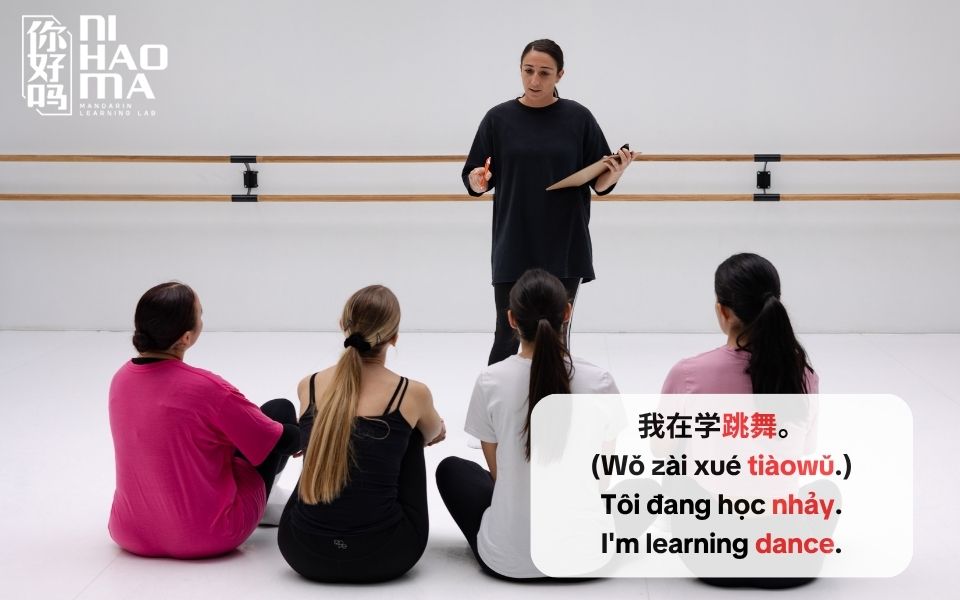
B: 我在学跳舞。
Wǒ zài xué tiàowǔ.
I’m learning dance.
A: 难不难?
Nán bu nán?
Is it difficult?
B: 刚开始有点难,因为要记很多舞步。
Gāng kāishǐ yǒudiǎn nán, yīnwèi yào jì hěn duō wǔbù.
At first it was difficult because I had to memorize many dance steps.
A: 学了多久了?
Xué le duōjiǔ le?
How long have you been learning?
B: 快三个月了。
Kuài sān gè yuè le.
Almost three months.
Dialogue 3
A: 博物馆离地铁站远吗?
Bówùguǎn lí dìtiězhàn yuǎn ma?
Is the museum far from the subway station?
B: 不远,大概只有五百米的距离。
Bù yuǎn, dàgài zhǐ yǒu wǔbǎi mǐ de jùlí.
No, it’s only about 500 meters away.
A: 那我们走路过去吧。
Nà wǒmen zǒulù guòqù ba.
Let’s walk there.
B: 好啊,沿着这条路一直走就到了。
Hǎo a, yánzhe zhè tiáo lù yìzhí zǒu jiù dào le.
Sure. Just follow this road straight ahead and you’ll arrive.
A: 这里的路标很清楚,不怕迷路。
Zhèlǐ de lùbiāo hěn qīngchu, bú pà mílù.
The road signs here are clear, so we won’t get lost.
Conclusion
As you can see, gaining a deep understanding of radical 157 in Chinese is much more than simply knowing another character component. It unlocks a logical mindset that helps you deduce word meanings instantly and master real-world conversations.
If you are looking for a structured Chinese learning roadmap, creative and intuitive teaching methods, and close guidance from an experienced pedagogical team, do not hesitate to take your very first steps on your journey to conquering Chinese with us!
Leave your information or contact Ni Hao Ma directly today to receive a personalized learning roadmap consultation and grab our latest tuition fee promotions!